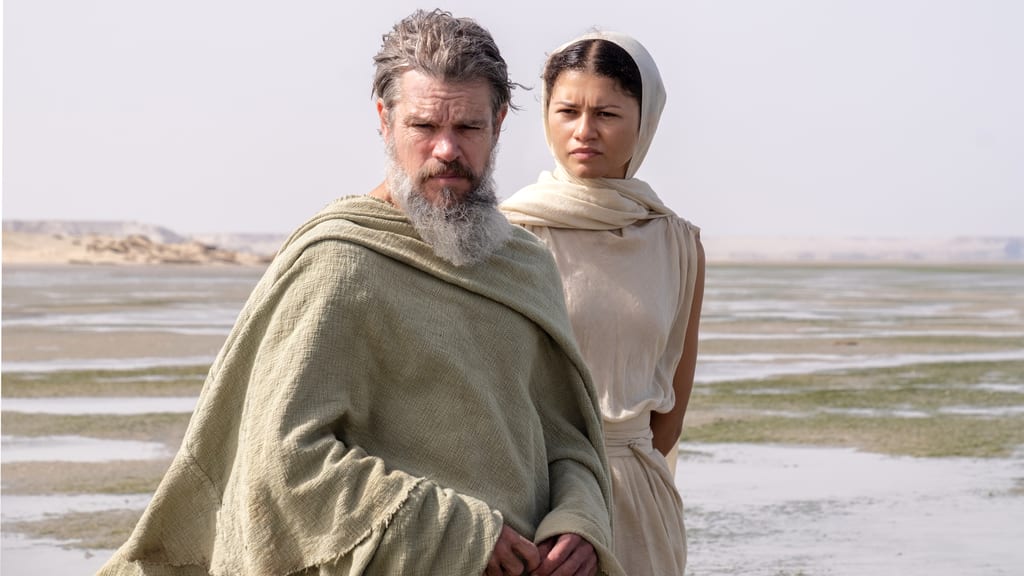
“I’m sorry, but an Ancient Greek would never wear that…” may have been the thought that kept resurfacing while you were watching Christopher Nolan’s ‘The Odyssey’ (2026). Whether you have an awareness of the historical period within which Homer’s epic originally took place or not, it’s not hard to infer that the sleek, almost 3D-printed looking armour, and Shein-esque mesh slip dresses seen on-screen aren’t entirely accurate. But what does an expert think of the costumes in this century’s biggest iMax blockbuster?
That question is why we asked fashion historian, Victoria Piscador, the brains behind social media platform studying Latin and Greek literature, languages, mythology and history, The Classical Thread, her thoughts on the historical accuracy of Nolan’s epic film, ‘The Odyssey’. Setting the scene for her take on the film’s costuming, Victoria felt it important that she determine exactly which time period we need to compare it to, in order to confirm whether Nolan’s ‘The Odyssey’ is accurate or not. As Victoria explained, “Although “the Trojan War” is a myth, as depicted by Homer [it] would have probably taken place in the Late Bronze Age, around 1150 BC.”
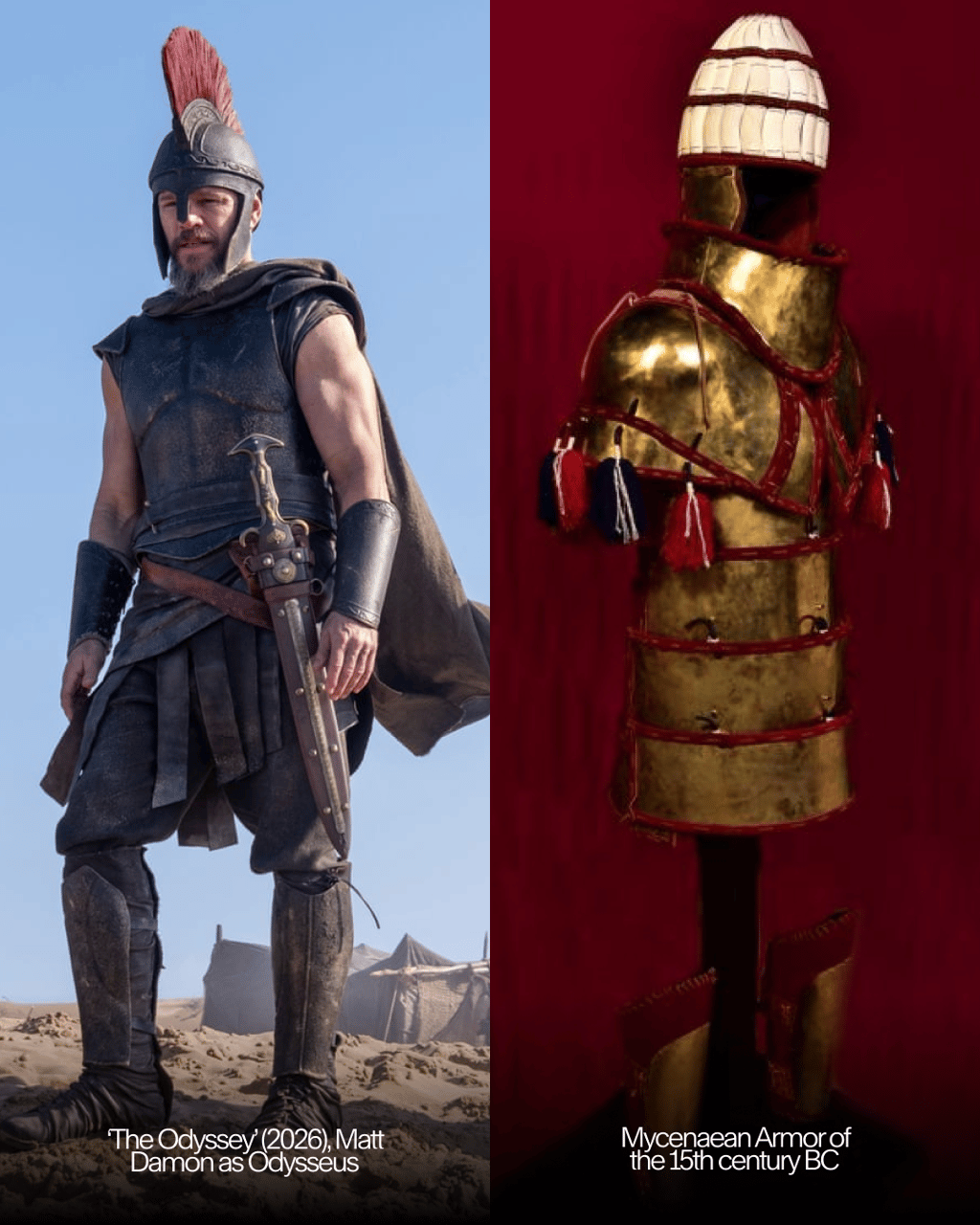
First looking at the armour worn by Odysseus (played by Matt Demon) and his men, Victoria Piscador pointed out that “[when] comparing Nolan’s version to that time period, we can clearly state that the armours look nothing alike. We have real Mycenaean armours (and the Mycenaeans were led by Agamemnon) from the Bronze Age, like the Dendra panoply (named after the archaeological site). Basically this was made out of bronze scales, and a headpiece of ivory scales.”
Victoria elaborates that the use of bronze for armour during the Bronze Age was key, but also the impractical, curved plates that armour of the era was designed from. “[They’re] not really practical or flattering at all, so I can see why they didn’t think it looked good enough to put in a highly anticipated Hollywood movie.” While the bleak, colourless, and stark appearance if most characters’ armour in Nolan’s adaptation might feel more accurate to modern viewers, Victoria reminds us that “ancient Greeks had lots of coloured and decorated clothing. Much more than we think nowadays. So the colourless costumes in Nolan’s version are a stark contrast to that.”
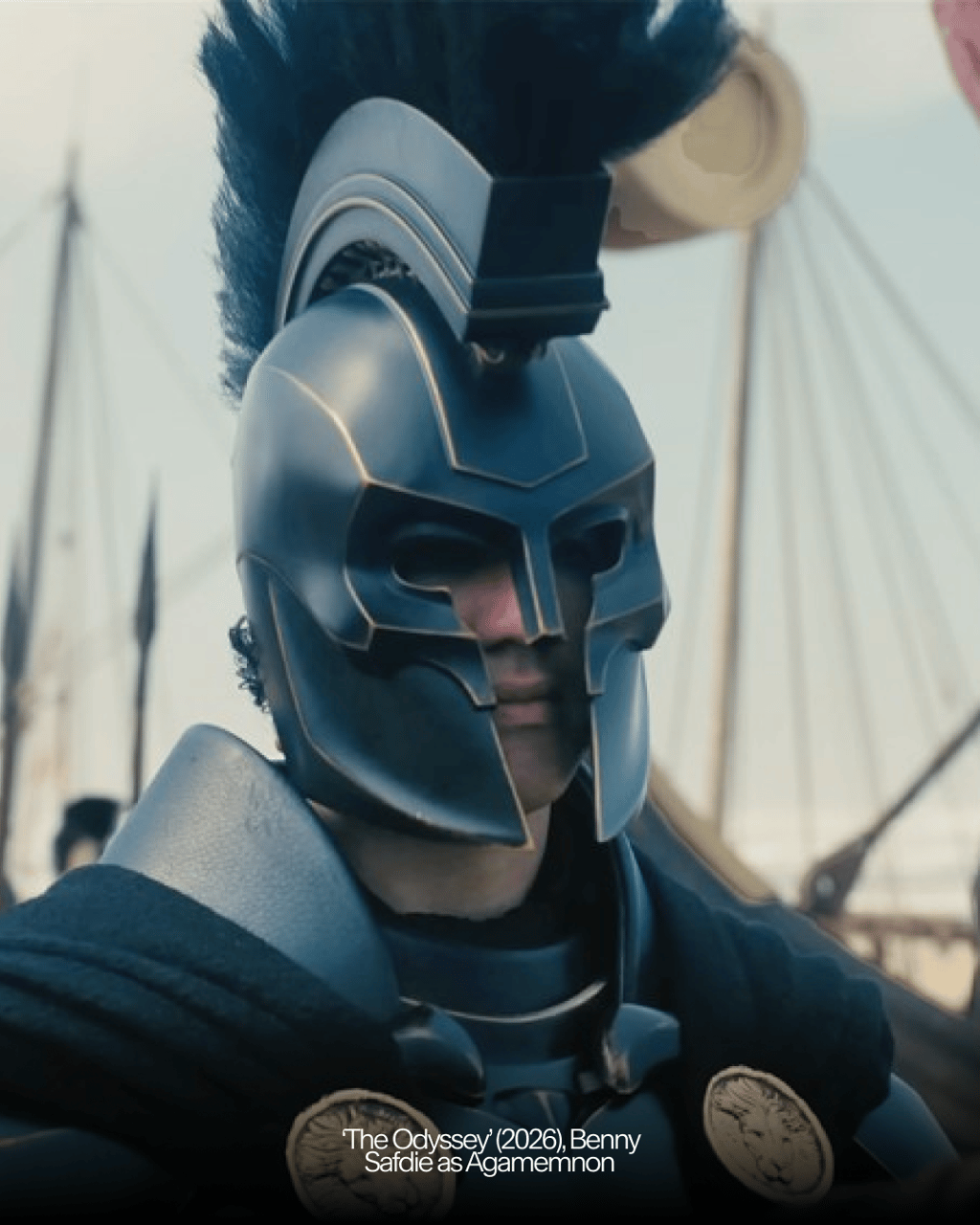
When we asked specifically about the controversially modern armour that Benny Safdie’s character Agamemnon wore in the film, Victoria admitted, “I understand that the goal, I think, was to give Agamemnon an impressive look, being not only the leader of the camp but also quite arrogant, someone who lets his men do the dirty work. And like with the other armours, a historically accurate look might not have really conveyed that fully to a modern audience. Nonetheless, the black matte finish just reminds me of an advertisement for an expensive sports car, and it just makes him look surreal in an artificial, futuristic way instead of a mythological one. Personally I think it pulls you out of the story, unfortunately.”
Similarly, Victoria Piscador had thoughts in the authenticity of Calypso’s wardrobe (played by Charlize Theron). In Greek mythology in general, and Homer’s story too, Calypso is a nymph and the daughter of the Titan Atlas, which means her character is non-human, derived from the divine. As Victoria explains, “in [translations of] Homer’s ‘The Odyssey’, Calypso is [described as] wearing a silvery dress and golden belt, and is represented as powerful, seductive, not of humble origins at all—she is divine after all.” In Nolan’s adaptation, her costuming is quite plain, neutral, and subdued by comparison, hardly reflecting the mythical wardrobe we’d expect of a the daughter of a Titan or God.

To conclude our discussion we had to ask Victoria Piscador whether she felt that Christopher Nolan’s inaccyuracy in terms of the costuming in ‘The Odyssey’ had a negative impact on the experience of the viewer. She shared that, “I don’t believe adaptations should be completely accurate, although I’m a classicist—or maybe because of it. Ancient authors imitated and adapted stories all the time, not only to emulate the great poets and writers before them, but also to showcase their own originality, skill, and talent. Originality came from changing small details of a traditional story.”
“I personally would have liked to see more respect to that tradition, even if it’s more in details rather than precise historical accuracy. The costumes do look very modern, whether the matte black finish of Agamemnon’s mask or the netting dress of Calypso, and I think it is distracting from the story and hinders the immersive experience a bit. As an audience, you don’t need perfect historical accuracy, just the feeling and impression that it could be accurate.”
Interviewee profile: Victoria Piscadoris a classical languages scholar, researcher, and educational content creator from Belgium. She is known for founding The Classical Thread, an online outreach platform designed to make classical Latin, Greek, mythology, and literature accessible to a global audience.